Showing posts with label Sports. Show all posts

Tuesday, April 29, 2025

Contesting: The Competitive Side of HAM Radio

I finished my last ice hockey game of season in early April, but I didn't stop competing. This past weekend I participated in another competition, albeit a competition way different than ice hockey. I competed in the Florida QSO Party with my "team," the Portage County Amateur Radio Service (PCARS) from our club site in Ravenna, Ohio. The Florida QSO party is one of 50 state "Contests" that take place on weekends each year inviting any licensed amateur radio operators, and clubs like ours to compete and earn awards by contacting other stations, clubs and operators in certain locations during a period of time. 

Various award earned by PCARS
When I typically talk to people unfamiliar with HAM radio, I often focus on the practical aspects of the hobby. It teaches you all about waves, frequencies and signals, which we rely on constantly in our daily lives when we use radios, smartphones and WiFi. It could be necessary in an emergency, if cell service or power goes down -and PCARS does have volunteers who work for the county's Emergency Management Agency that train every two weeks for such an event. Amateur radio also allows a portion of the airwaves for amateurs to experiment with new wave forms, digital protocols, and communication technology that may help to drive innovation for the future. In fact, this is exactly why the Federal Communication Commission holds certain parts of the radio spectrum available for licensed amateurs like myself. But, what do we do with all this technology when there aren't any emergencies or communications problems that need to be solved? We have fun, of course! And, along with DX'ing, meeting new people from all over the world, and chatting with other HAM's in the local community, Contesting is a big part of that fun. 

So, what exactly is a Contest in terms of amateur radio? In the simplest terms, it's a competition to see who can contact the most individual radio operators and stations in a given time period. You use your radio to listen for other stations transmitting, or call out to request that other stations find you. Once you connect with someone, and they can hear you, you exchange some basic information, usually their call sign (the alpha numeric designation all licensed amateurs use to ID themselves over the air), their location and other details, such as a sequence number, a signal report or other pieces of information described in the rules of the Contest. Once you've got all the info you need from the other party, you'll write or type that information down, and submit it to the Contest officials after the competition is complete. The officials will then reconcile each submission to confirm that both parties made contact and gathered the correct info from one another to confirm a contact (or "QSO" as we often call it). Most of this is done digitally now, through SQL or other database software.

Award my team received for the Washington QSO Contest
Scoring depends on each individual Contest's rules. In most state "QSO parties" scoring is different for in-state contestants versus out-of-state contestants. In-state contestants may get points for both in-state and out-of-state contests, while out-of-state contestants may only get points for making contacts within the hosting state. For example, when competing in the Florida QSO party last weekend, my group from Ohio was only looking to call into Florida, as we wouldn't be awarded for making contacts elsewhere. This way, the state hosting the party is the focus of much of the radio activity that day. Additionally, extra points may be given for achieving certain goals like contacting someone from each county (or parish) in a state, or contacting one or more "special" stations, such as stations set-up in state parks, landmarks or points of interest. It's a bit like completing a "side quest" in a video game, or catching that "rare" Pokemon. 

Most Contests have different categories, so people with a wide range of interests can participate. Typically there are individual entries and group or team entries, but with those categories, different contestants can get awards in various categories, such as most VHF/UHF contacts, most CW (or Morse code) contacts, or most contacts on each HF band, etc. So there are usually a lot of ways to win or place, regardless of your interest. You can also uses contests to find new contacts on the radio, even if you aren't participating in the contest; as you can imagine, radio activity will increase in each state when they hold their contests, and this gives any amateur an opportunity to listen for and make contact with contest participants in a given location. 

When I first started in amateur radio, I did so because I wanted to learn about the technology, communicate with other countries and be prepared in case of an emergency. So, when I first joined PCARS, I was a little weary of "Contesting". I already played ice hockey, and the prospect of winning and losing was stressful enough. What if I sucked? I would be letting the whole team down! 

Images for our outdoor Parks-On-The-Air contest in January
Thankfully, PCARS and the amateur radio community at large are some of the nicest and most welcoming people you'll ever get to know. Just because it's a "Contest" and it's scored, doesn't mean it's stressful. Usually we simply stay on the radio only as long as we're comfortable. Some participants will work from their home rigs, and send in their contact sheet afterwards, and others will come to the club site and compete for a few hours each weekend as they have time. And each contest is a great opportunity to socialize, not only with the contacts you make on the air, but with other participants at your club or station. 

Good food is usually required as well. This past weekend, I not only got 5 contacts on the 20 meter band in the state of Florida, I also got two slices of pepperoni pizza, a Boston cream doughnut from Maggie's in Middlefield, Ohio, and all the Dr. Pepper I could drink! Not a bad way to spend a Saturday. 

Monday, January 6, 2025

The Joys of Ice Hockey

When I was a schoolboy, I had a particularly crabby English teacher. If she wasn't giving long-winded lectures on topics unrelated to the books she assigned, she would sit at her desk and observe us while we read the book ourselves.

During one of these "reading" periods, I happened to fall asleep at my desk. I woke to that teacher slamming a hardcover book on the desk... the desk on which my head was resting. 

"I'm sorry" I said,"I had a hockey game last night, and I'm kinda tired." 

She snapped, "What's more important to you, Stephen? School or Hockey!" 

"Do you really want to know the answer?" was my reply. 

It was, of course, hockey.

That day, I made an enemy of that teacher. But, I made a classroom of friends (most of them were at that game). 

It seems like ice hockey was in my blood from a young age. Even though my parents didn't play themselves, they took me to Kent State NCAA Division-I hockey games as a kid, because we happened to live very near an ice rink in Kent, Ohio. My father actually got to be an extra in the film Slapshot which was filmed in Johnstown, Pennsylvania. I played in a tournament in that same rink more than a decade later.

I could go on at length about my hockey stories... Meeting the legendary Czech, and hall-of-fame Pittsburgh Penguin, Jaromir Jagr; Billeting in Embro, Ontario for a US-Canada Hockey exchange; and playing on the ice of Nationwide Arena, home of the NHL's Columbus Blue Jackets. But, I digress.... 

Basically, in my younger years, I was a pretty good hockey player. Not great, but good. I believe my peak was going to the Mid-American USA Hockey Development Camp tryouts. It was a big deal. I even got to skip two days of school to travel to Toledo, Ohio to participate. I didn't really have any goals in-mind other than to do the best I could, and get some extra skating time in. Yet, I found myself skating, and competing with the best hockey players of my age-group. They towered over me and out-weighed me. I knew I was not going to be selected from the first minute I stepped on the ice. But, I participated, and I actually made some good plays -enough to get a nice pat on the shin pads from my bench-mates, and a slap on the helmet from a few coaches. 

I didn't get selected. Afterwards, I was more tired than I have been my entire life. I was glad I did my best, and I skated with future NHL and AHL players. I could share the same rink with them, and get their acknowledgements when I did make a (rare) nice play. And, when I went back to playing high school hockey, I played like I was on fast-forward, and the rest of the players were on slow-motion. It was one of the best learning experiences I've ever had in any subject, professional or otherwise.

When we valiantly bowed out of the OHSAA playoff to a far-superior team my Senior year, I was more relieved than sad. There was college and marching band to look forward too; but mostly, I was grateful that I never had to do another practice, sprint or conditioning drill ever again. With my evenings free, there lay ahead of me a multitude of possibilities: jobs, colleges, girls, partying, golf? They all seemed a lot better than watering the ice rink with my sweat. So, that was it, I gave-up hockey.

Wish me luck, boys.
Yet, I miss the salty smell of sweat on my fingers. It lingers after games and practices, even when you've showered and and scrubbed with soap. I miss the smell of the rink, and the flavor your car gets after hauling hockey pads around all week. I miss the calluses that build up on your palms from tightening your skate laces each night. And, I miss the boys. My teammates. 

Apparently, hockey is, in-fact, in my blood. Because, in-spite of all logic, at 38 years of age,  I have signed up for an upper-level men's league hockey team. According to my doctor, I'm overweight and have high blood pressure. I'm pretty sure I can't jog a mile without stopping, and I have aches and pains that happen randomly whether or not I workout. 

Could hockey really be the answer? Could it really be better than eating healthy, taking my doctor's prescriptions, and having a brisk walk every morning? 

Do you really want to know to the answer? 

I'll let you know after our first game.

Monday, September 2, 2024

RETROSPECTIVE: Spurious Signals: Technology, Espionage and Football

As we officially end week one of the college football season, I thought I'd take a look back at an article I wrote about the new rules allowing in-helmet radio communication in games. After hundreds of games played over the past weekend, the system seems to be working quite well. In my observation, there was little noticeable difference visible to the casual fan, and -had TV the announcers not mentioned the change- I would hardly have noticed myself. 

Will Howard with ear-hole blocker in helmet
It seems the only minor issue may be that hearing the speaker in the helmet may be difficult for the Quarterback during offensive possessions, as they would often pause for seconds at a time cupping their hands over the helmets' ear-holes to better hear the audio. But crowd noise has always played a factor, and a Quarterback being unable to interpret the call from the sideline amidst the noise has been a part of the game forever. It's actually one of the more exciting characteristics of the sport; fans can actively impact the game by getting loud and interfering with one team's communication.

Interestingly, The Ohio State University, who plays in the enormous Ohio Stadium, seating 100,000-plus noisy fans, may have already planned for this. Their Quarterback, Will Howard, had a helmet which appeared to have an apparatus on the ear-hole to block the noise. I did not notice any other teams using such a device, and I'll be curious to see if more begin to appear in week two. Or, if ear-hole cover designs for The Riddel SpeedFlex or Schutt F7 helmets start popping up on 3D printing websites? Maybe I should buy a football helmet to craft one of my own for The Fabrication Lab. 

A few final things I noticed were that the hand signals and signs were still very much a factor, though likely not as noticeable to the spectator. NCAA rules currently cut-off in-helmet communication in the final 15 sections of the play clock. Additionally, with only one player selected to wear the radio helmet, other players would no-doubt still benefit from visual cues. So, as I predicted, any advantage or disadvantage brought fourth by the new rules, are very much determined by the humans playing and coaching the games (for now), and not the technology itself. The more talented (and better-prepared) teams take advantage of the new rules, while the rest fall short. So, in many ways, very little has changed. 

If you're interested, please give my old article on in-helmet communication in college football below a read, as well as Katie Lindendoll's intriguing article on ESPN.com, which provides a lot of critical and well-researched info on the subject...


Spurious Signals: Technology, Espionage and Football

For anyone who's never paid close attention to a college football sideline, it may look like a troupe of prop comics dancing all at once. The signs, props and posters are all part of a complex coding system intended to relay plays and strategies to the players on the field without tipping off the opponents. But beginning in Autumn of 2024, things will look much different. Prompted by a high-profile scandal involving sign-stealing, the National Collegiate Athletics Association (NCAA) will adopt in-helmet radio communications between coaches and players.

With a presumably private line of communication between player and coach, there will no longer need to be a system of audible and visual queues to coordinate strategies on the field. Or will there? Will radio communication end sign-stealing, and even the playing field? Or, will it complicate things even more? 

In-helmet coach to player radio transmissions are common place in professional football already, and so far the results appear to be good. The National Football League (NFL) allows one player on offense (typically the quarterback) and one player on defense to hear play calls and advice from the sideline via a small radio in their helmet. Now, college football, often bound by history and sense of old-school tradition, has finally followed suit. 

As both an amateur radio operator and avid football fan, I was immediately curious about how these radio communications would be protected. How sophisticated are these radios? Is a sports team or league well-enough prepared to offer fully encrypted end-to-end communication without the possibility of transmissions being intercepted or blocked by bad actors? That may sound paranoid, but when you consider that the NFL is a close-to 20 billion dollar per-year industry, and that collegiate sports generate hundreds of millions for universities, conferences, coaches and now the players themselves, the financial pressure to cheat must be at an all-time high. Additionally, with recent legalization of online sports gambling, third parties now have another way to potentially cash-in on illicit activities involving sports. Could radio waves be a way to hack the system?

I, as an inexperienced amateur radio operator, can surreptitiously listen in on a lot of seemingly private radio conversations. With a scanner, I can pick up police, public works, commercial and aviation communications very easily. The Uniden BC125AT scanner, which retails at about $105 (USD) not only scans through all available radio frequencies stopping on any "hits" or active/open conversations, it also scans for and prioritizes privacy tone, or DCS/CTCCS, protected calls as well as "Close Call" hits that originate within a certain distance. With the Uniden, I can hear air traffic control, police, emergency services, commercial, GMRS, MURS and family walkie-talkie communications within reception distance. This would include business, event and organization, security, parking and other radio-to-radio communications. When programmed correctly, I don't even need to know there's a conversation happening, the scanner simply searches all frequencies and stops when it gets a hit.

If I take my Uniden to the airport, I can hear the gate attendant talk with the baggage crew on the runway, the pilots or airport security -assuming they are using a commercially radio or walkie-talkie. If I go to a NASCAR or Formula 1 car race, I can hear the drivers talk to their mechanics during the race. With a strong enough antenna (but still small enough to fold and carry in a small bag), I can even hear the astronauts on the International Space Station. So, I thought, what type of radio systems are these football teams going to be using to relay schemes and strategies with the potential to win or lose a game? If, I, an inexperienced amateur, can eavesdrop on police transmissions and air traffic, what protections are in place to stop an advanced user with better equipment from accessing a team's private channel? 

Thankfully, if the NCAA adopts the same security protocols as the NFL next season, players and fans can be relatively confident that no such spy-craft will be happening. A 2012 article by Katie Lindendoll on ESPN.com explains it better than I can. According to Lindendoll's article, and Dan Viglione, former employee of the Federal Communications Commission (FCC), the NFL's system is quite sophisticated. It involves encryption (which is illegal for amateur use), and both teams' communications are monitored by the league office. Unlike a standard walkie-walkie or GMRS radio, where transmission occurs directly from one user's radio to others, the NFL helmet radios transmit audibly, only to a central hub somewhere in the stadium and then connect the audio to a press box or the sideline. The transmission is digitally encrypted, so even if a person managed to find which frequencies were carrying the message -which is illegal, if done intentionally- all they would hear is fuzz, if anything at all.

The same happens when a coach in the press box or on the sideline talks back to the player wearing the helmet. During this process, the league monitors for any abnormalities such as jamming or spurious interference, which while possible, would likely block both teams radios, as well as other phones and devices in the area. If such a thing were to happen, officials could stop the game, and locate the culprit. 

Essentially, the helmet communications are a slightly more sophisticated version of your cellular or WiFi network. Your phone calls and texts don't go directly to the recipient, they go to an antenna somewhere nearby, forwarded to the intended recipient, and get decoded on the listener's end. And, it is very illegal to look for or attempt to decipher messages on the cellular bands. In this way, your cell provider acts like a hardwired switching board protecting your call each step of the way. (It's why you can be sure I'm not listening in on your private cellphone calls). Your WiFi network works like a mini cell service in your own home with the router acting as the switchboard. If you have your network set-up properly using WPA-type encryption and a strong password (that you don't give away readily!), the data in your home should be just as safe. 

The key factor here is less about the technology and more about the common-sense physical steps we as people take to protect our privacy. A well-secured network is only as good as the password it uses, and how well we protect that password. If our WiFi access info is written on a Post-it note, and someone else sees it, it's not the technology that failed, but the person who put the code out there for any passersby to see. Can we be sure that the staff members working for both the teams and the league are taking the appropriate steps to secure access to helmet radio communications? Who outside of the teams and officials could have the access info, or simply be present while a coach messages a player?  

From instant replay in football to the shot clock in basketball, just about every sport has adopted some sort of technology on the field of play. Whether it's for officiating or strategizing, teams and officials have slowly but surely adopted technologies invented for commerce, science and governing for the purpose of competition. While sports tend to lag behind broader society in adopting technology, the possibility to gain an unfair or illegal advantage, or to cheat, has always been present. It's no surprise, then, that as technology in sport grows so to do the vectors from which bad actors can game the system, including electronic communications.

College football seems to be the latest battlefield in the fight to keep playing field equal for all teams. A high-profile cheating scandal involving this past year's national champion, and nationally popular football powerhouse, The University of Michigan Wolverines, erupted in the mid-2023 season. A paid member of the Michigan coaching staff was caught at multiple opponents' games filming the teams' sidelines, in an apparent attempt to record and break future opponents' vocal and visual signal codes. After the revelation, many of Michigan's opponents expressed that they had long held suspicions that something was afoot, that somehow Michigan knew what plays their competitors intended to run in advance. If this all sounds a bit too outlandish, like something out of a Cold War spy novel, you clearly have a lot to learn about college football in the United States. It is that crazy. 

The Michigan scandal is still being investigated by both the Big Ten conference and the NCAA, and the result remains to be seen. Furthermore, sign-stealing and code breaking have been common place in both professional and amateur football since the invention of the sport itself. It's actually not against the rules to try and de-code a signal system during the game itself. What Michigan is accused of is traveling to future opponents' facilities and filming games where they are not involved, which is illegal. Still the NCAA regulations themselves allow for a considerable "grey area," where the line between breaking and bending the rules is often thin. 

Will radio communication lead to a more well-defined rule book, and put an end to this sort of rule-bending, or will it further complicate ethics surrounding the sport. Worse, could it lead to methods of cheating so clandestine and advanced that they go unnoticed by both fans and officials? Only time will tell, but until the results are clear, lets hope the only interceptions happening in football are those involving throwing and catching the pigskin. 

Lindendoll, Katie, “Are NFL teams hacking helmet headsets,” ESPN.com, ESPN, 2012.  

Sunday, January 14, 2024

Spurious Signals: Technology, Espionage and Football

For anyone who's never paid close attention to a college football sideline, it may look like a troupe of prop comics dancing all at once. The signs, props and posters are all part of a complex coding system intended to relay plays and strategies to the players on the field without tipping off the opponents. But beginning in Autumn of 2024, things will look much different. Prompted by a high-profile scandal involving sign-stealing, the National Collegiate Athletics Association (NCAA) will adopt in-helmet radio communications between coaches and players.

With a presumably private line of communication between player and coach, there will no longer need to be a system of audible and visual queues to coordinate strategies on the field. Or will there? Will radio communication end sign-stealing, and even the playing field? Or, will it complicate things even more? 

A college coach advises a player

In-helmet coach to player radio transmissions are common place in professional football already, and so far the results appear to be good. The National Football League (NFL) allows one player on offense (typically the quarterback) and one player on defense to hear play calls and advice from the sideline via a small radio in their helmet. Now, college football, often bound by history and sense of old-school tradition, has finally followed suit. 

As both an amateur radio operator and avid football fan, I was immediately curious about how these radio communications would be protected. How sophisticated are these radios? Is a sports team or league well-enough prepared to offer fully encrypted end-to-end communication without the possibility of transmissions being intercepted or blocked by bad actors? That may sound paranoid, but when you consider that the NFL is a close-to 20 billion dollar per-year industry, and that collegiate sports generate hundreds of millions for universities, conferences, coaches and now the players themselves, the financial pressure to cheat must be at an all-time high. Additionally, with recent legalization of online sports gambling, third parties now have another way to potentially cash-in on illicit activities involving sports. Could radio waves be a way to hack the system?

I, as an inexperienced amateur radio operator, can surreptitiously listen in on a lot of seemingly private radio conversations. With a scanner, I can pick up police, public works, commercial and aviation communications very easily. The Uniden BC125AT scanner, which retails at about $105 (USD) not only scans through all available radio frequencies stopping on any "hits" or active/open conversations, it also scans for and prioritizes privacy tone, or DCS/CTCCS, protected calls as well as "Close Call" hits that originate within a certain distance. With the Uniden, I can hear air traffic control, police, emergency services, commercial, GMRS, MURS and family walkie-talkie communications within reception distance. This would include business, event and organization, security, parking and other radio-to-radio communications. When programmed correctly, I don't even need to know there's a conversation happening, the scanner simply searches all frequencies and stops when it gets a hit.

If I take my Uniden to the airport, I can hear the gate attendant talk with the baggage crew on the runway, the pilots or airport security -assuming they are using a commercially radio or walkie-talkie. If I go to a NASCAR or Formula 1 car race, I can hear the drivers talk to their mechanics during the race. With a strong enough antenna (but still small enough to fold and carry in a small bag), I can even hear the astronauts on the International Space Station. So, I thought, what type of radio systems are these football teams going to be using to relay schemes and strategies with the potential to win or lose a game? If, I, an inexperienced amateur, can eavesdrop on police transmissions and air traffic, what protections are in place to stop an advanced user with better equipment from accessing a team's private channel? 

Thankfully, if the NCAA adopts the same security protocols as the NFL next season, players and fans can be relatively confident that no such spy-craft will be happening. A 2012 article by Katie Lindendoll on ESPN.com explains it better than I can. According to Lindendoll's article, and Dan Viglione, former employee of the Federal Communications Commission (FCC), the NFL's system is quite sophisticated. It involves encryption (which is illegal for amateur use), and both teams' communications are monitored by the league office. Unlike a standard walkie-walkie or GMRS radio, where transmission occurs directly from one user's radio to others, the NFL helmet radios transmit audibly, only to a central hub somewhere in the stadium and then connect the audio to a press box or the sideline. The transmission is digitally encrypted, so even if a person managed to find which frequencies were carrying the message -which is illegal, if done intentionally- all they would hear is fuzz, if anything at all.

The same happens when a coach in the press box or on the sideline talks back to the player wearing the helmet. During this process, the league monitors for any abnormalities such as jamming or spurious interference, which while possible, would likely block both teams radios, as well as other phones and devices in the area. If such a thing were to happen, officials could stop the game, and locate the culprit. 

Essentially, the helmet communications are a slightly more sophisticated version of your cellular or WiFi network. Your phone calls and texts don't go directly to the recipient, they go to an antenna somewhere nearby, forwarded to the intended recipient, and get decoded on the listener's end. And, it is very illegal to look for or attempt to decipher messages on the cellular bands. In this way, your cell provider acts like a hardwired switching board protecting your call each step of the way. (It's why you can be sure I'm not listening in on your private cellphone calls). Your WiFi network works like a mini cell service in your own home with the router acting as the switchboard. If you have your network set-up properly using WPA-type encryption and a strong password (that you don't give away readily!), the data in your home should be just as safe. 

The key factor here is less about the technology and more about the common-sense physical steps we as people take to protect our privacy. A well-secured network is only as good as the password it uses, and how well we protect that password. If our WiFi access info is written on a Post-it note, and someone else sees it, it's not the technology that failed, but the person who put the code out there for any passersby to see. Can we be sure that the staff members working for both the teams and the league are taking the appropriate steps to secure access to helmet radio communications? Who outside of the teams and officials could have the access info, or simply be present while a coach messages a player?  

From instant replay in football to the shot clock in basketball, just about every sport has adopted some sort of technology on the field of play. Whether it's for officiating or strategizing, teams and officials have slowly but surely adopted technologies invented for commerce, science and governing for the purpose of competition. While sports tend to lag behind broader society in adopting technology, the possibility to gain an unfair or illegal advantage, or to cheat, has always been present. It's no surprise, then, that as technology in sport grows so to do the vectors from which bad actors can game the system, including electronic communications.

College football seems to be the latest battlefield in the fight to keep playing field equal for all teams. A high-profile cheating scandal involving this past year's national champion, and nationally popular football powerhouse, The University of Michigan Wolverines, erupted in the mid-2023 season. A paid member of the Michigan coaching staff was caught at multiple opponents' games filming the teams' sidelines, in an apparent attempt to record and break future opponents' vocal and visual signal codes. After the revelation, many of Michigan's opponents expressed that they had long held suspicions that something was afoot, that somehow Michigan knew what plays their competitors intended to run in advance. If this all sounds a bit too outlandish, like something out of a Cold War spy novel, you clearly have a lot to learn about college football in the United States. It is that crazy. 

The Michigan scandal is still being investigated by both the Big Ten conference and the NCAA, and the result remains to be seen. Furthermore, sign-stealing and code breaking have been common place in both professional and amateur football since the invention of the sport itself. It's actually not against the rules to try and de-code a signal system during the game itself. What Michigan is accused of is traveling to future opponents' facilities and filming games where they are not involved, which is illegal. Still the NCAA regulations themselves allow for a considerable "grey area," where the line between breaking and bending the rules is often thin. 

Will radio communication lead to a more well-defined rule book, and put an end to this sort of rule-bending, or will it further complicate ethics surrounding the sport. Worse, could it lead to methods of cheating so clandestine and advanced that they go unnoticed by both fans and officials? Only time will tell, but until the results are clear, lets hope the only interceptions happening in football are those involving throwing and catching the pigskin. 

Lindendoll, Katie, “Are NFL teams hacking helmet headsets,” ESPN.com, ESPN, 2012.  

Tuesday, July 25, 2023

Slap Shot: Secretly Feminist, pro-LGBTQ & pro-Labor?

As a young hockey player that skated with guys from both North and South of the Canadian-United States border, Slap Shot was required viewing. The 1977 film about a failing minor-league ice hockey team, directed by George Roy Hill and written by Nancy Dowd, was essentially a cult classic among hockey dudes like myself -mostly, for the fighting, and the brutal hits. 

The Charlestown Chiefs
Now, Slap Shot may not be a film suitable for a young child; and, if you're particularly sensitive, it may not be suitable for you either. The film depicts, in my view, a very accurate representation of what a hockey locker room in 1977 might have looked and sounded like. To give you a hint, there is a lot of language that would be considered beyond-the-pale today: lots of "f***s," "d***s", "c***s" and other words we'd never want to utter to someone public in these days. But, before anyone gets too worried about the message of the film, it's very much the opposite of the hyper-violent, hyper-masculine and somewhat bigoted stories of its characters. Slap Shot is actually, secretly, about women, sexual identity and labor in a capitalist society. 

The first hint that the film might be deeper than a simple montage of fighting matches between washed-up pro hockey players, is in the first act when Ned Braden (played by Michael Ontkean) tells coach Reggie Dunlop (played brilliantly by Paul Newman), that the steel mill in Charlestown (the fictional home of the team), is shuttering, and leaving tens of thousands of workers without jobs or income. The writing is on the wall, when the factory goes, the town goes... and so go the Chiefs, Charlestown's hockey team. "These people aren't going to have money to spend on hockey games," Ned says. 

From that point forward Newman's character, Dunlop, hatched scheme after scheme to try to save the team from bankruptcy by using violent antics to bring in frothing crowds of frustrated, angry, blue-collar fans who just want to see their Chiefs kick butt! If the Chiefs can fill the seats, they may just have a chance to stay in business, and the boys on Dunlop's team can continue their careers in the sport they love. Dunlop goes pretty far too; he even goads an opposing player into a fight by suggesting that his wife may prefer women to men -though don't get too mad at him, because that player was very likely abusive to his wife in the first place. If you don't watch and listen carefully, this may all sound a bit crude. However, you must consider that this was a film depicting hockey goons in the 1970's -people weren't as sophisticated back then. And, very importantly, our hero Reggie Dunlop never suggests he has any issue with homosexuality or the LGBTQ community. He just used some language we wouldn't use today. 

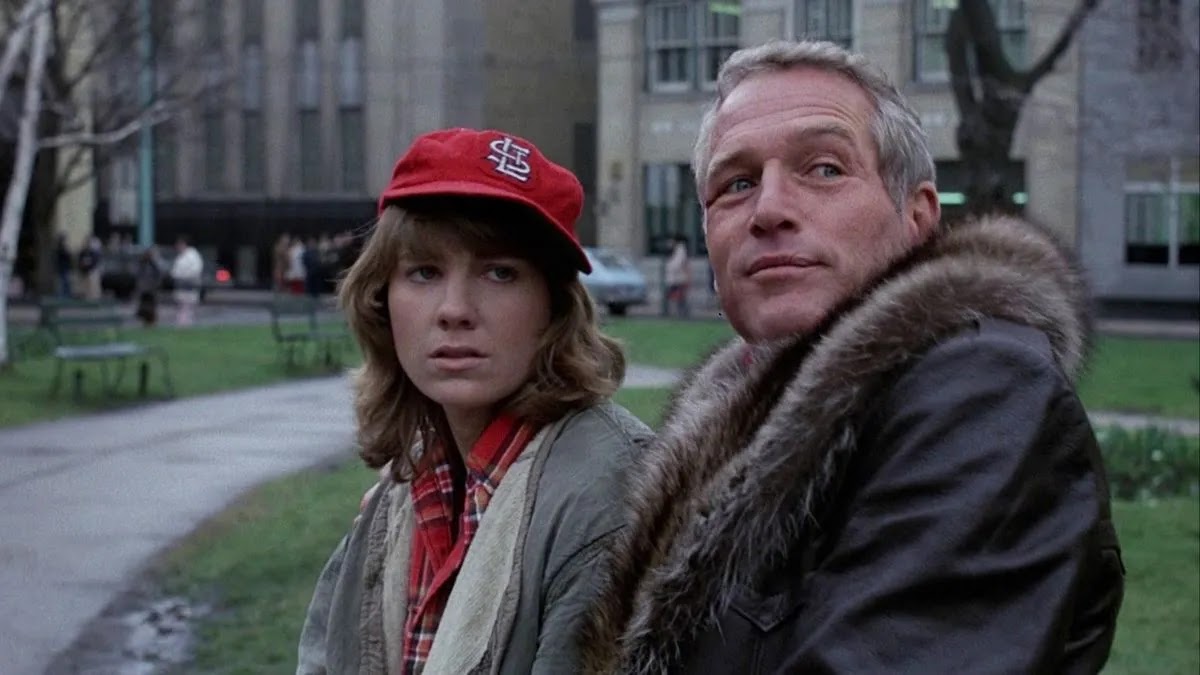
Lily (Lindsay Crouse) attempting to cope
One of the most important plot lines of Slap Shot is the story of the women who, despite everything, stand by and tolerate their terrible hockey playing boyfriends and husbands -and, at least one woman who broke free of her marriage and went on to create a wonderful life for herself! If you get the chance to watch this beautiful film, pay close attention to the women. They are more than half of the story. They go through hell to support their partners, showing up in the middle of the night to greet their men when they return, win or lose. One in particular, Lily (played by Lindsay Crouse) has a particularly difficult time dealing with her hockey player partner. Who could blame her?

When I watched the movie as an adult, it made so much sense that the screenplay itself was written by a woman, Nancy Dowd. She had written the script, in part, to tell the story of her own brother's trials in the brutal world of pro hockey. But, she didn't simply succeed in creating a film about hockey. She captured a very broad working class North American experience involving the beauty of the sport, as well as the violence. But, more-than-that, she captured a slice of American and Canadian life that involves the challenges every low-life, good-for-nothing, steel town faces when the big-money company pulls-up anchor and moves out, leaving the workers holding the tab. 

Roy Hill, George. Slap Shot, Universal Pictures, Universal City, California. 1977.   

Monday, July 3, 2023

NASCAR & Community: A Beautiful Thing.

I recently mentioned that I am a radio guy; a guy who likes radios. But, I'm also a racing fan; a guy who likes race cars, and cars in general... This Fourth of July Weekend in Chicago presented a wonderful opportunity to explore and enjoy both of those passions!  

I had the very unique opportunity to attend the the very first NASCAR Street Race on the iconic city streets surrounding Grant Park in Chicago. It was AWESOME!. 

However, I wanted to spend a little bit of time explaining how my experience was enhanced by my little radio.. 

My Little Radio

With my little, pocket-sized, Uniden BC125AT radio I was able to tune-in every team and driver on the course: Their communications, warnings about blind turns, water on the track, engine problems etc. The thing about auto racing is that you can't see all the cars, all the time. So, you must rely on technology like radios, cameras, and sensors to know how well your favorite car is performing against other drivers. 

Listening to the radio was excellent, and kind of fun! We watched the Grant Park 220, the very first stock-car street race in the United States. However, even with premium passes, we could only see the cars when they roared through the strait-away. Once they turned, and passed onto Roosevelt, Michigan and Dusable Lakeshore Drive, they were out of view. This, is when the radio was helpful. 

Not only could I hear the team speaking to their drivers, I could hear the NBC broadcast crew -even during commercial breaks; "3-2-1... and, Kim you're on...". You could see NBC's professionals in action, really working beautifully to make sure everyone enjoys this crazy stock-car race in the middle of Chicago!

Enjoying myself, but listening in...
Speaking of professionalism, the teams' and divers' radio frequencies were very impressive as well. These drivers, and men and women in the pits, really do a great job maintaining their $100,000 (USD) and up Super Cars, and supporting their brave drivers. Everything I heard was a very short and informative tidbit; something like: "Watch out on turn 4 for water," or "Let's check the car on the next safety lap." For a race that has everything to do with speed, patience and professionalism seemed to win the day! 

So, I'll close by saying that Car Racing is one of the coolest things us humans will get to experience in this world; fast, loud machines, and the technicians who help those cars go! If you're interested in this sport, check it out. It's a great way to meet new people, see (and hear!) some awesome cars and have a wonderful time! 

And, if you're a Super-Nerd (like me), think about getting a radio to listen in on the action.   

Popular Items