Friday, May 19, 2023

Preview: Erik Davis's TechGnosis: Myth, Magic & Mysticism in the Age of Information

I first discovered Erik Davis, and his somewhat "out there" academic work via his podcast Expanding Mind around 2019. From there I started his newest book, and PhD thesis, High Weirdness, and ultimately ordered his earlier work, TechGnosis. As someone interested in understanding and documenting the weirdness of the past four to five years and the hyper-speed jump into artificial intelligence society has taken in the past year, I felt a bit disappointed when I cracked TechGnosis to find it was written and published way back in 1998. I mean, what's he going to talk about, MySpace, Hacky Sacks, Netscape, blogs? Back then, Amazon was just a book retailer for %#$!'s sake...

A Mystery Portal
That said, I should have known Davis would not disappoint. TechGonsis is a timeless and creepily prophetic lesson in technology and how it both obfuscates and conjures up the magical, spiritual realms of our experience. Technology, Davis argues, not only secularizes and rationalizes our world (creating modern solutions to practical problems), but also opens unintended portals into the age-old religious and mystical worlds.  As TechGnosis astutely points out in the first chapter, technology is not a new thing.  It has always been. The most-mind blowing and disruptive technical achievement of man was likely not the Moon landing, artificial intelligence or the splitting of the atom, it was probably language and writing itself. With the written word, pictographs, and later alphabets and numbering systems, humans took a quantum leap toward corralling and taming the natural world around them, and the thousands-year march toward modernity smart phones and space travel began. So, if you're out there looking for a Singularity or Year Zero, consider that the ship may have sailed about 150 to 250 thousand years ago when the first guy made a picture that was supposed to mean "yummy plants nearby", "don't go over there" or "Jeff was here" and other dudes got the message long after Jeff left.

What the hypothetical caveman, Jeff, did was simply attempt to organize his natural world into a more manageable place, and make things easier and simpler. But, it didn't stop there. At a cosomologically rapid pace, letters turned into words, which turned into books, which turned into holy scripture. Numbers, turned into arithmetic, which turned into equations, which turned into algorithms that turned into Google. With the power of documentation, and increasingly mobile and convenient forms of publication, each generation came up with an enhancement that built on the previous generations' novel technologies. One of my favorite historical anecdotes from TechGnosis is the story of the Ptolemys, the descendants of Alexander the Great, who ruled Alexandria of Egypt from roughly 300 BC to 50 AD. They commissioned the Great Library of Alexandria, which is often believed to be one of the first attempts at a comprehensive depository of all knowledge. One of Ptolomys, Davis writes, was so into obtaining and cataloguing data he actually seized any ship sailing into port and forcibly confiscated all scrolls and writings the crew had on them, returning them only after scribes were able to copy them down. So, think about that before you get too upset about Mark Zuckerberg mining your personal information. 

If you've studied philosophy, history or any similar humanities subjects, this is all pretty well-established stuff. Humanity in its ever-expanding technical prowess conquered the natural world with science and machines, and now we have time to invent even more neat stuff because we're not preoccupied with finding food and avoiding snakes. We've even passed the point where we started asking ourselves why, with all this modern knowledge, there is still poverty, gross inequality, war, crime addiction etc? And why, in times like these, does it actually seem to be getting worse, not better? As Davis and multiple well-know philosophers have already pointed out, technology and knowledge never means "progress," only change. We create this handy stuff to make our lives easier and to get farther away from the cold, scary wilderness of nature and the superstitions and myths of the past, but it always comes back. Technology may start as a way to organize and control the world around us, but it always comes back around as a portal from which the weird, mystical ideas of the past re-emerge, and send us looking toward the natural untamed realm for answers. 

Davis provides ample historical evidence for his ideas in the first chapter "Imaging Technologies". Although he includes numerous examples, I was particularly interested in his descriptions from the Ptolemys' Alexandria, the Egyptian metropolis, just prior to it's swallowing by the Roman Empire. It was a port-of-call on the mouth of the Nile connected by land, river and sea to all of the growing regions and city states of Europe, Africa and Asia. It exploded in growth around this time attracting a myriad of immigrants from countless ancient cultures. It was a multi-lingual, pan-religious, cosmopolitan city, where money was made, arts and culture were developed, science was advanced and people with different ideas both mingled and clashed. The cacophony of Alexandria is very similar to major cities in 2023. In spite of the technological explosion that was happening at that time relative to earlier periods -with ever more grandiose buildings, complex machines (2) and countless other advancements ostensibly invented to make living easier and to make resources more abundant- people still turned toward the mystical and spiritual. Newer cults, ecclesiastical traditions and full-blown religions, including Christianity, were seeping out of every cultural crack that Alexandria and its engineers opened on their quest for new knowledge and new gadgets.

Without spoiling too much more of TechGonsis, I'll close by saying that I love Erik Davis' writing style. He makes fun of himself a bit in his forward to the 2015 re-print of his 1998 book by mentioning some of his dated 1990's lingo. But as a child of the 90's myself, I find it all too rad. In spite of it's weighty subject-matter, Davis' writing is accessible to both academic and layperson. In fact, rather than highlighting, Post-it noting and jotting down notes on every other page, I found it more enjoyable to just plow through it like a spooky Stephen King novel or one of those neat historical docu-drama series on Netflix. If you're into the subject matter enough to really nerd out, go ahead and re-read it with more purpose and attention. 

TechGnosis: Myth, Magic & Mysticism in the Age of Information was published by North Atlantic Books in 1998.

Monday, May 15, 2023

Integrations

Last week I reviewed the 1987 film "Robocop" about a futuristic policeman augmented with super-human abilities. When we think of human augmentation we often think of someone like the Robocop, a normal person with physical attachments and implants that allow them to do and see things others can't. In media and gaming the idea is ubiquitous: think The Borg, Iron Man and Master Chief as examples. However, the truth about human augmentation is actually a lot simpler, so simple that we rarely think about just how connected we are at all times, even without eye implants and rocket boots. 

It's mentioned (far to often) that people are addicted to their devices. Sure there's truth to that, but it was a cliche to say so more than a decade ago, now it's just getting annoying. It's like saying we're addicted to food, money or water. This is why I prefer to think of technological augmentation not as a physical attachment, but as a series of integrations.

Some kind of bubble cafe
In technical terms, an integration is any way two or more systems interact with each other. You add a bit of HTML and JavaScript code to your webpage to pull anything from the weather, stock market quotes or sports scores onto your site; now your application is integrated with Accuweather, Bloomberg and ESPN. Your work's payroll system is integrated with its customer relationship management system and it's qualitative reporting systems, so all the information each wing of the organization is seeing is synchronized and updated in real time. This allows everyone access to all the information they need immediately, and drastically reduces the need for clerks, couriers, typists etc. An old colleague of mine said it best: "integration is when the computers talk to each other, so we don't have to."   

We don't have physical brain-plugs, like in the Matrix, or infrared vision, like in Robocop, but our eyes, ears, voice and fingers are the perfect ports from which to send and receive an ever-increasing amount of information. Some readers may remember a time when you had to literally write a check then balance your checkbook by hand after each purchase to know how much money you had at a given point in time. If the calculation was off, or you skipped a few calculations and couldn't find the receipts, the only way to know was to go to your physical bank branch and ask them for the available balance in your account, or wait until a statement was mailed to you. If you had stocks, equities, high-yield savings bonds, etc. you could forget about calculating the value yourself. You could either wait for your monthly or quarterly statements to arrive, or hire a professional to keep an eye on your finances for you. Now, all of our financial information is available to us where ever we go. With the click of an app, you can look across multiple accounts, see interest accrue and stock values go up and down in real time. You can transfer money from one bank to another, sell stocks, and re-pay a friend for dinner from your phone in less than the time it used to take to wait in line at the bank to deposit a check. You are now integrated with your entire financial universe at all times. What used to take one or more days of errands, and interactions with multiple tellers, associates and clerks, is now fully accessible to you at a moment's notice.

It doesn't end there either. My credit card is integrated with my ride share app. My airline app is integrated with my federal known traveler identification, and it's all integrated into my brain via my eyes, ears and finger-tips. I can now wake up, get dressed, make a car come pick me up, book a flight to nearly anywhere in the world, walk through TSA Pre-Check and takeoff -all without ever reaching for my wallet or carrying a single dollar of cash. The only thing I'd need to remember to take is my passport, and the only time I'd truly need to speak with another person is if I make the alarm go off at airport security. Not even Robocop, with his sophisticated mechanical implants could manage that, and it would be significantly harder for him to get through that metal detector. 

Human augmentation is happening, and it's happening faster than ever. We adopt it without a thought, let alone hesitation, because it makes sense, and it makes our lives easier. Best of all, unlike a robo-suit, eye implants or a neural brain-plug, we can turn our devices off and put them down whenever we'd like. Plus, a phone and a set of wireless headphones probably don't hurt as much as a brain-plug. But, put me on the wait list for a set of Iron Man rocket boots.

Friday, May 12, 2023

Movie Review: Robocop (1987) "I'd buy that for a dollar!"

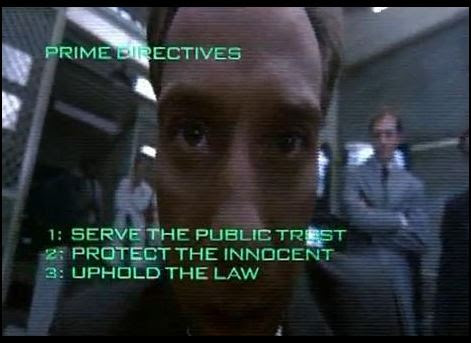
If California was home to a nexus of psychedelia and visionary experiences in the 1960's and 1970's, it was definitely a nexus of visionary blockbusters in the late 1980's and early 90's. Even though most kids of my generation were not old enough to see them in theaters, just about every boy my age not only saw Terminator II, Aliens or Predator on VHS multiple times, but had at least one or two action figures depicting characters (or Xenomorphs) from one of those great films. Which is why I'm surprised -and a bit ashamed- that I'd never seen the the 1987 Robocop, directed by Paul Verhoeven and written by Edward Neumeier and Michael Miner, until recently. And, boy does it stack up to the greatest sci-fi action movies of that era. 

Scene from Robocop 1987
As the name suggests, Robocop features a part-man part-robot cop who patrols "Old" Detroit in the near future. The crime-ridden and economically depressed city needs a masked, armored hero to save the day and blast the bad guys. Sigh... seems familiar enough, so maybe that's why I avoided this one until now. In a world of dime-a-dozen Marvel supermen, Batmans and vigilante "heroes," I didn't need to see yet another maverick cop blowing shoplifters away with a comically large pistol. No way was a move called "Robocop" going to age well into the current political and social climate. It was certain to be a paranoid orgy of violence, warping suburban America's view of the inner-city into a post-apocalyptic hellscape of lunatic criminals robbing, raping and murdering good, innocent, all-American folk. However, as I watched it became clear that Robocop, played by Peter Weller, was more than just Dirty Harry with robot armor and an even bigger gun. He was a complex, sympathetic figure who provides us with a frighteningly accurate look into humanity's future. 

The film begins in the boardroom of the powerful Omni Consumer Products corporation, a private multi-national industrial concern that supplies large manufactured goods, civil services and, of course, weapons to the government. Think Raytheon meets Halliburton plus Proctor and Gamble, etc. The company has just won a contract to run Detroit's police force and is eager to demonstrate their new 100 percent mechanical policing robot, the ED-209. SPOILER ALERT: the demo does not go well. With only a few months until Omni is set to take over the Detroit police department, they need a solution. Enter Robocop, a part-man, part-machine hybrid with the hardware to take down the criminals, but with the mind of a human to act with discretion.

In classic Paul Verhoeven fashion the first few scenes of the film demonstrate that what we're about to watch is more than a simple action movie. Sure, it's got all the explosions, gun battles and solid kills necessary to keep any adolescent boy (or adolescent-minded adult) interested. However, Verhoeven -who went on to direct Starship Troopers (1997)- shows us early-on that the film has a message that goes deeper than the simple good-guys versus bad-guys motifs. Between the lines, the film is critical of policing, but not anti-cop; it's suspicious of artificial intelligence, but not anti-technology; and above-all it shows how badly things can go when for-profit commercial entities, rather than institutions accountable to the public trust, are put in charge of running a society. 

I suppose any astute grown-up could have predicted in 1987 a lot of what was about to happen over the next 3 plus decades. Computers would have an increasing impact on our daily lives; the privatization of services traditionally provided by the government would have expected results; and robots would begin to replace human workers in every industry. However, given where we're at in 2023: with crime on the rise; policing strategies called into question; flying drones patrolling airspace firing missiles toward the ground on a regular basis; and revolutionary AI software poised to change everything we've come to think we know, you'd be hard-pressed to find a more accurate and entertaining vision of the future than Paul Verhoeven's Robocop.  

Verhoeven, Paul. Robocop, Orion Pictures, Los, Angeles California. 1987. 

Saturday, March 6, 2021

Preview: Erik Davis's High Weirdness: Drugs, Esoterica, and Visionary Experience in the Seventies

Erik Davis, a writer and religious studies scholar, has been a favorite of mine every since I discovered his podcast Expanding Mind. Part journalist, part psychedelic seeker and part scholar, he explores the world of shamans, mystics and believers of the paranormal while keeping one foot solidly in rigorous academic and journalistic skepticism. So, when High Weirdness, his PhD thesis from Rice University's Department of Religion, was published, I picked up a copy right away. 

Cover Art by Erik Roper

"Weird" may not strike readers as an academic term, but perhaps the broadest goal of Davis's book is to define "weirdness" within the scholarly discourse. "Weird" is a distinctly contemporary term, a common exclamation that crosses all class of jargon. If something is off, out of order or remarkably inexplicable, it's "weird!" Within a scholarly context, Davis argues, that weirdness occurs when something unexpected, or unexplained, breaks into our otherwise rational conscious reality. Weirdness is when a person or group of people see and experience phenomenon that disobey the rules of our rational world. Weirdness encompasses religious miracles (Jesus walking on water), hallucinogenic drug trips, UFO sightings and everything in between.  

To explain Weirdness in a religious setting, Davis explores three individuals: psychedelic seeker and ethnobotanist Terrence McKenna, countercultural figure and mystic Robert Anton Wilson and famed sci-writer, Philip K. Dick. Davis also explores the cultural milieu of 1970's California as a ground-zero for Weirdness -a sort of modern "holy" land of new mystical and religious movements, illustrated by the extraordinary experiences of McKenna, Wilson, Dick and their contemporaries. 

In his intro, Davis lays out an impressive academic groundwork, building on the theories of Michel Foucault, Georges Bataille and, most notably, William James. In the rest of his book, Davis hopes to examine the concept of weirdness in the California counter-culture of the 60's and 70's through the lens of religious studies.     

High Weirdness: Drugs, Esoterica, and Visionary Experience in the Seventies was published by The MIT Press and Strange Atractor Press in 2019.

Tuesday, March 24, 2020

Preview: Georges Bataille's The Accursed Share Vol. 2

After reading the preface of The Accursed Share Volume 2, I was comforted to know that I was at least as confused by Volume 1 as Bataille's contemporaries were. And, it seems that Bataille actually intended to confuse his readers a bit. "I do not now wish to dispel a malaise that I have deliberately provoked," he wrote. "I believe this malaise is necessary. Let one consider the abyss that is open for humanity!"  

Bataille does, however, connect some of the dots he laid out in his first volume. For example, he explains that Volume 1's study of General Economy focused on consumption, particularly needless consumption as an inevitable fact of human existence. Naturally, I found myself asking asking this: "If needless consumption -or profitless operation- is ethically beneficial, or if it fulfills a social need, is it not necessary rather than needless?" 


A woman walks through the Lurie Garden in Millennium Park
Bataille begins to answer this question by introducing the idea of eroticism. Eroticism, Bataille contents, is a base energy that has a huge impact on the human mind, and consequently on human behavior. Unlike sexuality, which is quite useful and necessary for reproduction, eroticism serves no purpose; it's the shameful taboo side of sex that's always present, but never acknowledged in polite society. Bataille makes clear here that he intends to shift his readers' focus from a study of energy consumption in the physical world, to a study of excess within the mind itself.

Anyone who has seen a middle aged man driving a two hundred thousand dollar sports car knows he's wasted that much of his wealth. But does the driver of that car know? In his own mind, he's getting something for the expenditure, prestige, excitement, and maybe something more. Perhaps he's captured the gaze of a beautiful young woman or man who would've paid him no such attention if he was driving, say, a Toyota. Then again, maybe that thought is just fantasy, the daydream of a man who should know better than to think a Ferrari alone would be enough to make up for his glaring insecurity. In either case, Bataille's leap from consumption to eroticism is an enticing turn.

The Accursed Share Volumes 2 & 3, published by Zone Books in 1991, is translated by Robert Hurley. The original book, titled La Parte Maudite, was published in France by Les Editions de Minuit in 1967.          

Monday, March 16, 2020

Reading Journal: Georges Bataille's The Accursed Share Vol. 1

I was eating escargot with a butter-encrusted slice of garlic bread at a chic bistro when my brilliant friend, and dinner guest, suggested I read Bataille. For reasons I still can't totally grasp, that seemed like an appropriate intro to Bataille's work. My friend, a PhD in the humanities, is about as knowledgeable about social theory as anyone could be, so when she suggested I read Bataille, and later gifted me a copy of The Accursed Share Volume 1, I didn't wait long before reading. 

The first chapter was hard to grasp, as Bataille attempts to describe his unconventional theory of "political economy," a term which Bataille himself concedes is insufficiently descriptive of his grandiose ideas. After reading and re-reading chapter one, I asked my friend if she could explain it for me. She said, "no one really gets it, just keep reading and don't think about it too much."    


I finished the book in a matter of days. "What the [EXPLETIVE] did I just read?" I thought, after closing the book. 


Let's start with that enigmatic, but provocative, chapter one. Bataille uses his first few pages to describe his idea of "General Economy," which has less to do with money and production, and more to do with energy consumption at it's very basic level. The sun feeds the plants, they consume its energy to grow and multiply, animals eat those plants and to do the same. General Economy, in Bataille's view is an ecology of consumption. Any individual, or system, of individual beings must consume some energy to survive, grow then reproduce. After that, if beings continue to amass energy, the excess becomes "wealth." 

Think about a financially well-off person whose home is paid off, and whose children are grown and independently successfully themselves. This person still works and makes money, even though they could retire comfortably. We'd call that extra money "wealth" in General Economy the same way we would in our conventional economy. Bataille claims that the extra money (or energy) must be consumed -not just spent but spent lavishly! (and without profit). Furthermore, he argues that the same is true of societies at large. When a nation or culture generates collective wealth they must also blow it all on something huge and unproductive, like a grand monument, a festival or a war.  

That kind of makes sense when it comes to our well-off man or woman; I've seen enough of them cruising around in their Tesla's. But what about the frugal millionaire? The one who still drives a Ford pickup or rides a scooter to the office? What exactly is forcing them to blow their cash so auspiciously? Well eventually it'll get spent one way or another I suppose. But, it's not individual wealth that Bataille is concerned with, it's societal wealth, which is even harder to get my mind around. But, it all kinda makes sense if you read on. 


To demonstrate his point, Bataille spends the rest of the book exploring the various way different cultures and societies have consumed their excess energies throughout history. Societies have always wasted their wealth in more or less normal ways since the beginning of recorded history, by erecting giant beautiful monuments and architecture, holding mass festivals, etc. But Bataille argues this is sometimes not enough to quench a collective thirst to consume the remaining share. That remaining wealth, the cursed share, will ultimately doom "multitudes of human beings" who are themselves ripe for consumption. 

Take the Aztec practice of ritual human sacrifice, which Bataille covers in gruesome detail in chapter two. The Aztec Empire, a military power of pre-Columbian America, practiced a religion that worshiped the Sun, the all-giving light without which no life would exist. To the Aztecs, according to Bataille, the Sun god created not only people, but also war and death, and the only way to repay humanities dept to it was to offer up life in return. This was why war, or conquest, was crucial to Aztec society. The greatest gift for man to offer was his life on the battlefield, and equally valuable was to capture a prisoner to sacrifice. 

But why not use the prisoner for labor, or incorporate them into the Aztec society? Therein lies the sacrifice. The sacred person, the victim of ritual execution, is not meant to be of service to you, he is meant to please the Sun, who gives all without anything in return. In fact, the victims of sacrifice were treated as sacred themselves, often being given luxurious feasts and treated as guests of honor for many days leading up to, well, the end. 

Another, less gruesome, aspect of this is "Potlach," a gift-giving ceremony also practiced by the Aztecs, and still practiced by some indigenous people of North America today. In Potlach, the point is to present a gift to your rivals, not to please or help them, but to humiliate them. To give a gift so valuable that they can't reciprocate it. You give a handsome gift, and your rival has a certain amount of time to return a gift of their own (of greater value). And this goes on until one rival can't out-gift the other. The loser, recipient of the final gift, must concede defeat. (But at least they got something really cool, I guess.)
The Norte-Dame Basilica, Montreal


Bataille goes on through history looking at similar cultural wealth/energy consumption traditions, ranging from the monks of Tibet, financially supported by lay people to meditate and study all day, to the great religious wars of Europe and the near east in the middle ages. If anything, it's compelling reading. Anyone who enjoys the detailed archeologies of Michel Foucault, or binges on Dan Carlin's hours long "Hardcore History" podcasts will enjoy Bataille's historic ethnographies.
       
So what's the point of The Accursed Share? What are we supposed to learn? That, apparently, was just as opaque to Bataille's contemporaries as it was to me. But, it seems as though he's artfully trying to give us an over-arching ethic about what to do when one society accumulates more wealth than it needs to carry on. At the end of the book Bataille, a Frenchman and democratic Communist who lived through World War II, praises the Marshall Plan, the United States plan to spend trillions re-building Western Europe after the war, without any expectation of re-payment. To preface this, he describes the brutal tactics the Soviet government used to force-industrialize the nation into a military power on par with the US. These tactics worked, but not without a brutal cost. Bataille was rightfully appalled by the Soviet-style of government; he believed the Marshall Plan was a critical strategy in challenging the rise of Soviet Communism and avoiding a third more devastating world war. The irony in this is that, in order to save itself from Communism, the US was forced to abandon it's own capitalist values of profit and give lavishly to war-torn Europe without the expectation of return. 

I'll let Bataille speak for himself here...   
Changing from the perspectives of restrictive economy to those of general economy actually accomplishes a Copernican trans-formation: a reversal of thinking -and of ethics. If a part of wealth (subject to a rough estimate) is doomed to destruction or at least unproductive use without any possible profit, it is logical, even inescapable, to surrender commodities without return."... "The industrial development of the entire world demands of Americans that they lucidly grasp the necessity, for an economy such as theirs, of having a margin of profitless operations. (25) 
So what is a "profitless operation"? A public library, an air drop of rice and grains, 50 percent off a Domino's hand-tossed pizza? An offering to the Sun god? And what is "wealth," or "excess?" A national treasury, a corporation's reservoir of stock, six months rent in a savings account, escargot? And how do we all fit into Bataille's General economy? Who should receive? Who should sacrifice? And what ultimately happens to the cursed share of the wealth if it's not usable? Those are questions not entirely answered in Volume 1, but maybe the point is just to ask them. 

The Accursed Share Volume 1, published by Zone Books in 1991, is translated by Robert Hurley. The original book, titled La Parte Maudite, was published in France by Les Editions de Minuit in 1967. 

Popular Items